Update, 2026. I no longer recommend Glowforge. The company looks shaky, and the xTool machines do more for less money. This review stays up because the technique and the workflow notes still hold, and plenty of people still own these machines, but it is not where I would put my own cash today.
What I recommend now for lasers: xTool. I have used more of their machines than anything else on the site, and my tools page lists what I reach for now.
The Glowforge Air Filter has come in handy during our freezing cold winter days, but it is not entirely good news, so I thought I would put my thoughts into this post to serve as a review of the compact filter and feedback on how things could be improved.
Do you want to laser engrave or do laser cutting with your Glowforge or other desktop laser cutter, but worry about annoying your neighbors, or don’t like the idea of pumping the smoke out of a window? Or perhaps, like us, you live in a climate not conducive to that?
Table of contents
Glowforge Compact Air Filter? What is it?
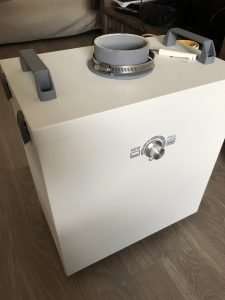
An air filter do what it says, it filters the air. Also called fume extractors, smoke filters, or air purifiers.
Glowforge’s air filter allows you to not worry about annoying neighbors, or when you live in a climate where venting outside is not possible.
Right from the start it seems Glowforge planned to have available a filter that would take the exhaust from the laser engraver and, rather than pump it outside, would take smoke into an enclosure, filtering it to produce clean air.
During production, they hit some speed bumps and came up with an alternative arrangement to serve folks who couldn’t wait for the planned version but turned out to have its own advantages.
After attaching the filter, you need to set an option to tell the Glowforge interface the filter is being used, that way it uses the filter fan rather than depending on the vent fan that is in the engraver.
What was the planned air filter unit like?
Unlike the Glowforge branded filter that is still in development, this filter sits beside the laser, and is attached using vent tubing.
While not as elegant as sitting under the laser as is still planned for the first-party solution, it offers the opportunity to decide when you want to pump the smoke outside or into the filter. You can filter or vent, it is up to you.
It is mounted on wheels, so is quite a bit more portable than the planned Glowforge branded filter also.
Pros and Cons of the Glowforge Air Filter
As mentioned earlier, the main advantage is the whole purpose, and that is the filter means you don’t have to pump the smoke outside.
Cracking a window lets the cold in. As well as being not fun for humans, it is especially bad for the laser to be exposed to extreme cold, and that cold goes right up the vent into the machine if you are not careful.
Another advantage of the filter is it also keeps the sound in. Lasering can be noisy for your neighbors.
If you wanted to, you could take your Glowforge and Compact Filter and do demonstrations or personalized gifts at markets, conventions, and other events. Definitely, something we are considering.
Right now it seems the filters, which are after all consumable, fill up quickly.
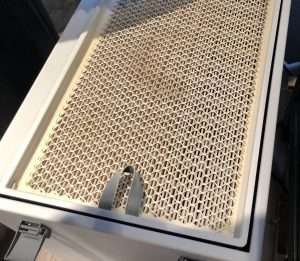
The advice is to limit the use of materials such as MDF to lengthen the useful life of the replaceable filters, which would be fine but 90% of what most of us engrave on our lasers is plywood, which has MDF inside.
This wouldn’t be bad if they were cheap, but they are $250 each. That and they are heavy and bulky, so avoid cross-border shipping and import duty if you can.
Some people suggest you add a pre-filter that snags the largest particles and buy carbon filters through Amazon or other regional options, some of these downsides could be mitigated somewhat.
As it is, I like that this filter goes wherever you want rather than strictly under the laser – we have the option of venting outside, and less of a pain in the butt each time the filter needs to be replaced!
Pros
- Really does clean the air.
- Quiter than expected.
- Portable.
- Easy to use.
- Higher quality assembly and filters than other units.
Cons
- Expensive up-front cost.
- Expensive replacement filters.
- Filters clog quickly.
- Big and heavy.
Air Filter Review Conclusion
While I have a gripe, it is minor in comparison to the benefit we received in being able to use our Glowforge right through -40c weather – essential as my wife launched a business off the back of the Glowforge that couldn’t take a vacation while the climate improved.
TL;DR: I’d recommend checking out the Glowforge Air Filter to anyone with a Glowforge or other desktop laser cutter, and despite the cost, I would suggest it as another advantage they have over other similar laser engraving systems.
Check out my original Glowforge Review for more information on why I still prefer the Glowforge over any other laser I have owned or used.

 Are You Making Soldering More Difficult than Necessary?