Once you have chosen your robot’s brain, next you need “actuators”, things that allow your robot to move and do other cool stuff.
In most cases you are at least going to want motors that drive wheels so your robot can scoot around, like a remote controlled car. That’s not all we will want to do, though. Consider the robots you see in movies. They have heads that move from side to side, hand-like grippers, it might be a flying robot, maybe even have guns that pop out and fire.
For our purposes there are several categories of motors and actuators we will work with:
- DC Motors – These are the motors you see everywhere. Apply power and the motor turns. It might have plastic or metal gears which will allow you to have different speeds and torque. Torque, put simply, is how “strong” the motor can be. You will want to balance speed and torque, especially if your bot is going to battle others, or push heavy weights around. DC motors range in price from a couple of dollars up to, well, something that would power a full size family electric car. There are two types of DC motor, brushed and brushless, but we will get into that later. For now, stick with the cheaper and easier brushed type, the regular kind of motor most people encounter and work with.
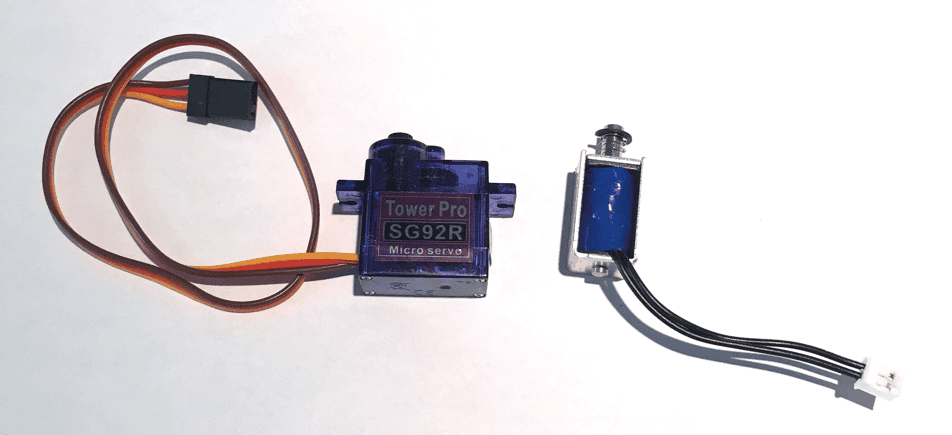
- Servos – Servos are a kind of motor that allows positioning. Instead of just applying power and seeing it run, you want to be able to predictably move the motor output to a position, somewhere between 0 and 180 degrees (though many don’t do that full range). These motors have circuitry to control and monitor that position. They are used in robots for things like opening and closing doors, animatronics, and pan and tilt. A special kind of servo (either bought or regular servos but modified) is the continuous servo. These work more like a DC motor in that instead of positioning at a certain angle, the signal instead controls speed and direction. The on-board circuitry makes them very easy to work with. Hobby servos are cheap and plentiful, with continuous servos usually a little more expensive than their regular counterparts, hence people sometimes take a regular servo and modify it to make it continuous.
- Stepper Motors – You will find stepper motors in your printer, CNC machine, and 3D printer. Steppers are used for precise movements (“steps”). If you want something to move exactly 30cm, this is the motor for you. Hobbyists have found a lot of uses for steppers, from stop motion control photography, through to animated Halloween displays. Due to their having millions of uses, it’s not hard to find stepper motors to buy at reasonable prices. The very cheapest eBay steppers are usually the small ones originally intended for use in HVAC and air conditioning systems, but then there are larger steppers used in cheap 3D printer kits.
- Solenoids and Linear Actuators – So far we have only looked at rotational movement, but you might want to create a linearmovement. If you have ever seen an electromechanical lock, it probably used a solenoid. They use electromagnetism to move in and out a tiny amount, but can be remarkably strong even in the smallest kind that we would use in our projects. For more movement you need a linear actuator, which tend to use a screw and bolt type mechanism to convert the rotational movement into linear movement. They can also be pretty strong and tend to use high torque motors to do the heavy lifting.